

The latest issue of Nature printed the paper by Nanjing University Professor Wan Xiangang on his team’s discovery of an efficient method to identify materials that host topological states, a major breakthrough from the traditional angling method to find topological candidates in the sea of materials.
The paper, titled “Comprehensive search for topological materials using symmetry indicators,” was published in the February 28 issue of Nature.
It was co-authored by scientists from Harvard University and was based on an exhaustive database search which revealed a large number of topological candidates that were later put into a newly developed topological material catalogue.
The Nature paper by Professor Wan Xiangang’s team
Topology, the mathematical study of shapes and their arrangement in space, has been reshaping physics in recent years. The topological quantum states of matter are now a subject of frontier research in condensed matter physics and material science.
In 2016, the Nobel Prize in Physics was awarded to three scientists “for theoretical discoveries of topological phase transitions and topological phases of matter.
Topological materials demonstrate intriguing physical properties that defy expectations based on properties of conventional materials and hold great promise for development in the electronic, telecommunication and semi-conductor industries.
The traditional method of finding a topological material is an inefficient target-oriented process: it first pre-assumes a specific topological phase and then calculates the corresponding topological invariants.
The new theoretical insights into discovering topological materials are of scientific value and broad application prospect.
Their technique is very different from conventional target-oriented searches and uses algorithms to sort materials automatically according to their chemical properties and properties related to symmetries in their structure.
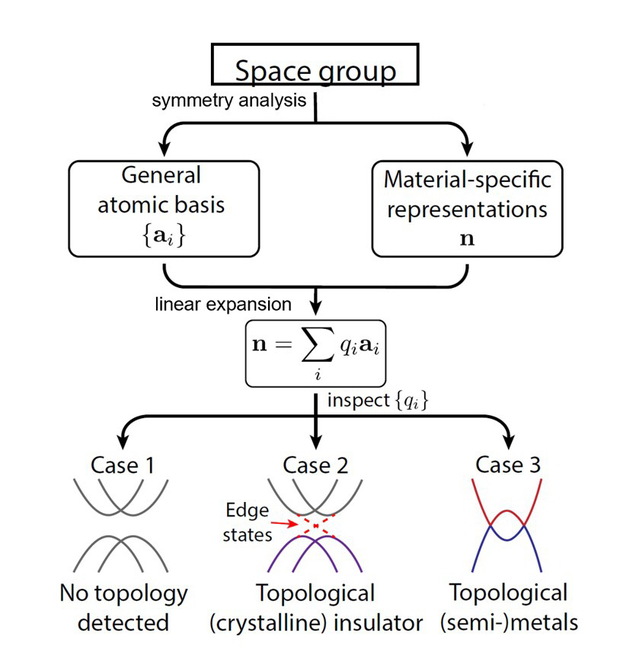
A flowchart of the algorithm of the team’s research using symmetric indicators
According to Professor Wan, their team developed a comprehensive method to predict whether a material can host topological states.
“This approach is capable of doing an exhaustive search in the entire crystal database to build a topological material catalogue,” commented Xing Dingyu, an academician of the Chinese Academy of Sciences and a professor at Nanjing University.
Xing believed the topological material catalogue will greatly benefit experimental physicists’ work in the future because it enables them to narrow down their research to the topological candidates highlighted in the catalogue instead of searching in the dark.
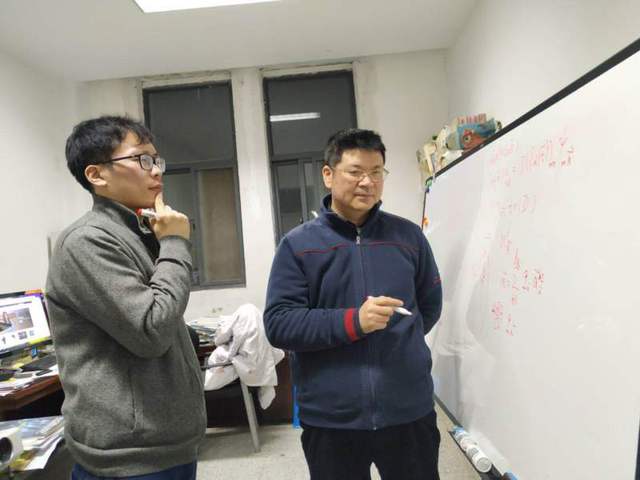
Professor Wan discusses with Doctoral candidate Tang Feng
When Professor Wan’s team began to develop their method in August 2017, their initial plan was to look for novel higher-order topological insulators. An ambitious exhaustive database search was subsequently carried out, and the team found that nearly half of the nonmagnetic materials could be classified as topological candidates after mass calculations.
The team listed 10,897 predicted topological materials (including the compounds with band crossing points located near the Fermi level) on a dedicated website named Topological Materials Arsenal, where their structure files and electronic bands are provided for reference and study by their fellow researchers.
Out of these candidates, they further selected nearly 1,000 representatives that have a relatively clean Fermi surface or band crossing points that are located nearer to Fermi level, and they predicted that further research could find topological candidates that are nearly ideal for practical use.
Doctoral candidate Tang Feng, from the university’s National Laboratory of Solid-State Microstructures, was the first author of the report, and Engineer Yao Ge, from the Collaborative Innovation Center of Advanced Microstructures, assisted in mass calculations with computers and in setting up the website.
“The topological material catalogue proposed in the report will pave way for further experimental and theoretical exploration,” said Professor Xing. “The approach is not just limited to electronic topological materials but can also be extended to magnetic materials and even acoustic or photonic systems. We can fully expect this comprehensive search method to become a trend in condensed matter physics and material science.”
On a side note, the same issue of Nature also reported the related research by the Institute of Physics, the Chinese Academy of Sciences, and that by a Princeton University team. The clustering of these papers shows that Chinese scientists are edging ahead of the rest of the world in the area of topological material design.

