

Dr. Li Changyu, a Chinese American specialist in crime scene investigation better known as the “contemporary Sherlock Holmes,” was awarded honorary professorship by Nanjing University during his visit to the university on March 21.
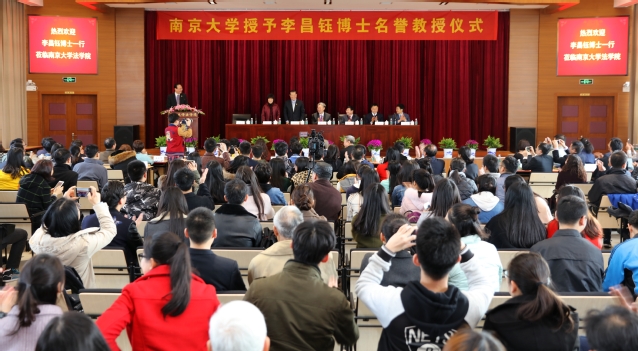
At the award ceremony, Xue Hailin, vice president of the university, read out the award decision on behalf of the university.
Lv Jian, academician of Chinese Academy of Sciences and exective vice president of the university, handed over the certificate of the professorship to Dr. Li Changyu and put the university badge on his suit.
In addition to the university leaders and law school students and professors, those present at the award ceremony included Song Miaojuan, Li’s wife, and Cai Chenghua, head of the Chinese American Federation and the Chinese American Jiangsu Chamber of Commerce.
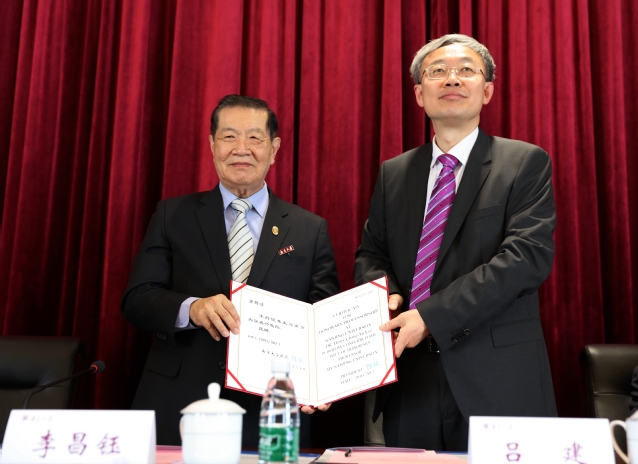
Xue Hailin spoke highly of Professor Li, who has returned and made contributions to his homeland by generously sharing his rich experience in criminal investigation and helping to cultivate many talents in the area of criminal investigation.
Nanjing University, said Xue, is promoting international exchange and cooperation in various areas in a new historical period in order to make itself into a world class university.
Its students will gain an opportunity to acquire the most advanced knowledge in crime scene investigation after Professor Li joined the faculty, said Xue.
Professor Li also made great contributions to the university by strengthening the development of the Law discipline, improving the quality of education and cultivating inter-disciplinary talents.
After the ceremony, Professor Li Changyu shared with the teachers and students his life experiences and opinions about some world- famous cases.
His two-hour talk impressed the audience with vivid and humorous language and with the mingling of lecturing and questioning.
Those who correctly answered his questions even received gifts from him, a paper “police emblem” and a card with his signature.
Li was born in Rugao, Jiangsu Province. He lost his father at a young age, moved to Taiwan with his mother, and later on went to the United States to attend university, work and make a living.
He worked in crime investigation under law-enforcement authorities for over 50 years of his career, having handled more than 8,000 cases in over 46 counties and regions around the world.
He has been awarded by various countries and organizations in the world for more than 800 times for the new concepts and methods of analysis he proposed in the area of crime investigation and for the contributions he made to the development of contemporary science of crime scene investigation.
Li smiled when he recalled his hard life as a student.
In 1964, 26 year-old Li went to the United States with only 50 dollars and two suitcases.
He worked as a waiter in restaurants, as a trainer of Chinese Kung fu, and as a technician in labs.
He finished his undergraduate education only in two and a half years while working on three jobs at the same time.
“I got my doctoral degree in 1974,” he recalled, “and I attended my graduation ceremony at home because, money was required for almost everything at that time in America and I did not have much money.”
Li encouraged young students to work diligently and to have their own dreams and passions by showing students his timetable, which has marked time periods for work, for meals and for sleep—with an accuracy of minutes and seconds.
The audience was impressed that this expert detective not only worked out many difficult criminal cases, but also published over 200 papers and over 20 books and edited more than ten journals in crime scene investigation.
He said that he did not write much everyday, but he would write at least one page a day.

Dr. Li said that he spent his whole life doing one thing, which is turning the impossible into possible.
One example is the crime scene investigation laboratory in Connecticut, which he built up from nothing. The office was a room remodeled from a men’s toilet and the employees were not as capable as Li had in mind.
Li and his colleagues started from scratch, built the laboratory and established the first team for fatal cases.
They combined scientific knowledge with real-life experiences and successfully solved many tough cases.
Li said that there are three kinds of people in the world: those who can successfully achieve something, those who watch others achieve something, and those who feel nothing even though the world has already changed. He encouraged students to strive to become the first kind of people.
“There will always be hope in life when one tries,” he said.
Li summarized five key points to success: honesty-oriented values; enterprising spirit which turns the impossible into possible; high efficiency which means making good use of every 24 hours; the principle of letting evidence speak for itself; and willingness to help others.
Li used specific cases to demonstrate the new theories of criminal detection in the 21st century and the process from obtaining evidence to scientific identification.
“From the US President to ordinary people,” he said, “I have investigated so many cases, and I have always been fair and let evidence speak for itself.”
It was with that principle that Li solved so many astonishing cases and was given the reputation of “a model in international justice science and police circles.”

