

A new breakthrough has been made in the research of global changes and terrestrial carbon cycling by the team led by Professors Zhang Yongguang and Ju Weimin and Academician Chen Jingming, from Nanjing University’s International Institute for Earth System Science and School of Geographic and Oceanographic Sciences.
As listed in the world top journal Science, the rate of global warming and the response to it by terrestrial ecosystems are one of the 125 major scientific issues to be addressed in the next 25 years.
Since the Industrial Revolution, human activities have caused a continuous increase of carbon dioxide (CO2) concentrations in the atmosphere, and such increase, while causing global warming through the greenhouse effect, also increases vegetation photosynthesis (i.e., CO2 fertilization effect or CFE) and increases the capacity of terrestrial ecosystems to absorb atmospheric CO2 (i.e., carbon sink capacity or sequestration capacity), thereby slowing down the speed of global warming.
Research shows that the atmospheric CFE is the main factor in increasing carbon sinks of global terrestrial ecosystems and driving global greening over the past decades. Therefore, quantifying CFE on the global scale and analyzing its spatial and temporal dynamics are essential for accurately assessing the carbon sequestration capacity of global terrestrial ecosystems and its changing trends and reducing the uncertainties in predicting the future climatic changes.
Although the mechanisms of CFE can be studied at leaf and canopy scales based on controlled experiments, the number, spatial distribution and species representation of the experiments are limited, and as a result, the quantitative assessment of spatial and temporal dynamics of CFE on the global scale remain unclear. Multiple long-term remote-sensing observations provide a data base for global CFE research. Therefore, based on a series of satellite sensor observations, this research first developed the global vegetation index (NIRv) from 1982 to 2015 to verify its feasibility as an indicator of global vegetation photosynthesis (i.e., gross primary productivity or GPP). On this basis, a detection and attribution model was constructed to assess the accurate global CFE, revealing its spatial and temporal dynamics for the past four decades and evaluating the possible uncertainties of the results. Finally, field data, such as leaf nitrogen and phosphorus observations in Europe and global terrestrial water storage provided by ICP Forests and other European institutions, are combined to reveal the possible causes of the spatial and temporal dynamics of the global CFE.
Research shows that the global CFE shows a significant declining trend over the last four decades (see Figure 1); the global CFE in 2001-2015 is remarkably lower than that in 1982-1996 (Figure 1). There has been a decreasing trend in CFE in more than 60% of the global terrestrial vegetation areas, especially in Europe, Siberia, South America, most parts of Africa, and western Australia, although there has been an increasing trend in CFE in a few areas such as parts of Southeast Asia and eastern Australia (Figure 2). The decreasing trend in global CFE can also be simulated in multiple ecosystem models, but the results are significantly lower than those based on remote-sensing data.
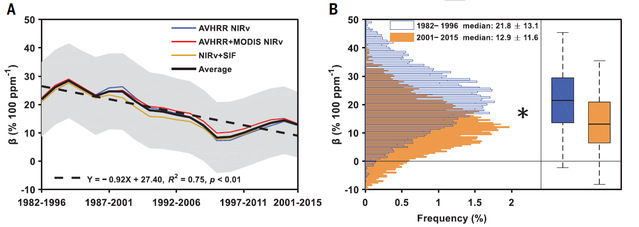
Figure 1. Long-term trends of global CFE in terrestrial ecosystems (A) and histograms of global CFE from 1982 to 1996 and from 2001 to 2015
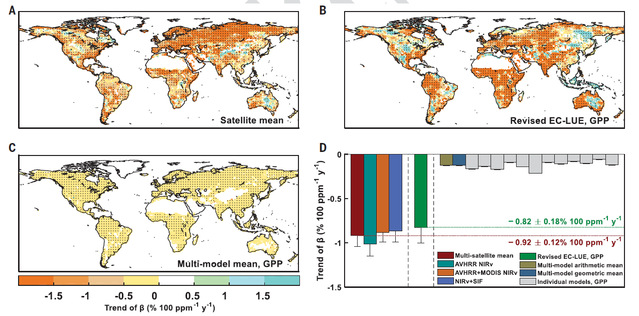
Figure 2. The spatial distribution of temporal trends in global CFE, (A) average results from multi-source remote-sensing data; (B) average results from the light use efficiency model; (C) average results from multiple ecosystem models; and (D) global average of the results from different methods
Further analysis, by using more than 30,000 observations of key nutrient (N and P) concentrations in forest leaves in Europe, shows that there is a significant decreasing trend in leaf N and P concentrations in European vegetation, and such changes remarkably affected the trend of CFE (Figure 3). Using remote-sensing data of terrestrial water storage as a water supply indicator, it has been found that the sensitivity of the remote sensing GPP to water supply was significantly increased, indicating that vegetation was more sensitive to water stress, and the change in water supply status might be one of the reasons for the decrease of CFE
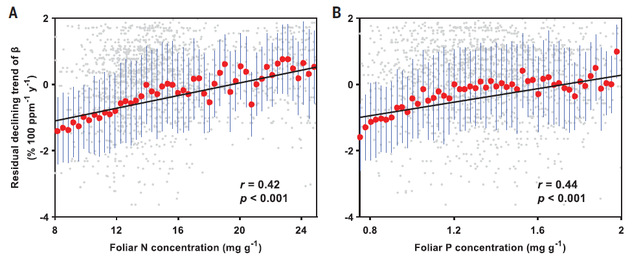
Figure 3. Effect of changes in nutrients (N and P) on CFE
The team led by Professors Zhang Yongguang and Ju Weimin and Academician Chen Jingming, from Nanjing University, was supported by the projects they lead, including Major Scientific Projects on Global Change, Research and Development Projects on Global Change and Key Response, Jiangsu Provincial Natural Science Fund (NSF) for Distinguished Young Scholars and the NSFC Projects of International Cooperation and Exchanges.
The team has focused on remote sensing of vegetation, optimal calculation of global terrestrial ecological carbon flux, and evolutionary characteristics of global terrestrial ecosystem carbon sinks and their driving mechanisms.
Based on the team's years of continuous efforts, the research led by Zhang combined the remote sensing of vegetation with global change ecology research and first quantified the spatial and temporal dynamics of global CFE over the past four decades.
The research results are of great importance for understanding the response mechanisms of terrestrial ecosystems in the context of global change, accurately estimating the carbon balance of global terrestrial ecosystems and precisely predicting the speed of future climate warming.
The research results were published in the latest issue of Science, titled Recent global decline of CO2 fertilization effects on vegetation photosynthesis. The first author of the paper is Associate Research Fellow Wang Songhan, corresponding author Professor Zhang Yongguang, and major co-authors include Professor Ju Weimin and Academician Chen Jingming.
Nanjing University is the hosting institution of both the first author and the corresponding author.
The major participants in this research came from Nanjing University’s International Institute for Earth System Science and School of Geographic and Oceanographic Sciences. The major collaborators include Professor Josep Penuelas from Universitat Autònoma de Barcelona, Professor Philippe Ciais from Laboratoire des Sciences du Climat et de l'Environnement, France, Dr. Alessandro Cescatti from the European Commission’s Joint Research Center, Professor Ivan Janssens from University of Antwerp, Belgium, and Academician Joseph A. Berry from Carnegie Institution for Science, USA.
This research has been supported by the National Key Research and Development Program of China (2016YFA0600200), the General Program of National Natural Science Foundation of China (42071388) and the Jiangsu Provincial NSF for Distinguished Young Scholars (BK20170018).
It has also received strong support from collaborating laboratories at home and abroad for data acquisition and validation.

