

A Nanjing University delegation visited Moscow State University, St. Petersburg State University, Moscow State Normal University, Hebrew University of Jerusalem, Israel Institute of Technology, and University of Bar-Ilan in an effort to deepen its partnership with these top universities.
The delegation led by Hu Jinboi, vice-chairman of Jiangsu Provincial CPPCC and secretary of NJU’s CPC committee, were in Russia and Israel from October 23 to 30.
Visit to Moscow State Normal University:Promoting cooperation projects in high-level teachers education
On the afternoon of October 23, Hu and the rest of the delegation visited Moscow State Normal University and had a friendly meeting with vice rector of international affairs Victor Dronov and rector's advisor Konstantin Dotsenko.
The two sides had extensive discussions on deepening and exploring the project cooperation in teachers education.
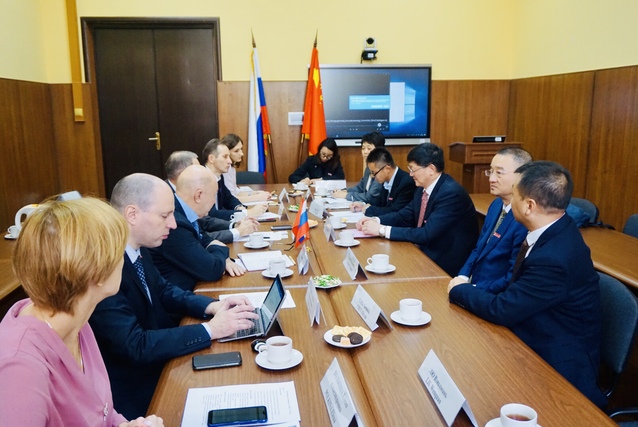
Pic.1 Discussions at Moscow State Normal University
During the discussions, Hu briefed the work and characteristics of Nanjing University and reviewed the achievements in the cooperation of the two universities in the construction of the discipline of Russian studies and in the training of Russian talents.
Hu also highlighted the efforts at further raising the teaching quality and nurturing teaching talents in answer to the call of the National 2035 Education Program. In this regard, the university has set up Xingzhi Teachers College, the first of its kind in China’s comprehensive universities.
Moscow State Normal University is highly experienced in teacher education, said Hu, and he hoped to strengthen the two universities’ faculty and student exchange, to construct a platform of research cooperation, and deepen the effective and down-to-earth cooperation.
Dronov agreed to the thoughts of Hu and expressed his wish to increase the faculty and student exchange, increase the communication on teaching methodology and curriculum construction, and carry out effective cooperation between the two universities.
Visiting Moscow State University: Promoting High-Level Chinese-Russia Joint Education Projects
On the afternoon of October 24, Hu and the rest of the delegation visited Moscow State University together with Cao Shihai, minister councilor of Chinese Embassy to Russia.
The delegation had a meeting with the university’s rector Antonovich Sadovnichy, together with vice-rector of international affairs Yuri A. Mazei, vice-rector of academics Pyotr Vrzhesheh and vice-rector of research Andrey Fedyanin.
The two sides had in-deep discussions on the joint establishment of the proposed China-Russia College.
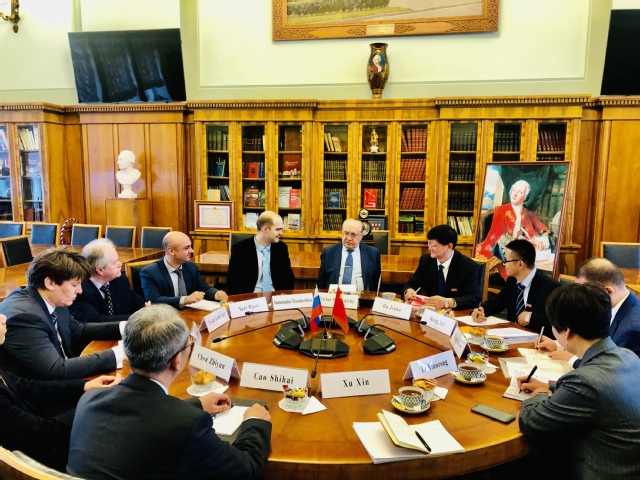
Pic2. Discussions at Moscow State University
During the discussions, Secretary Hu highlighted the progress of Nanjing University in the Double-First-Class construction and the university’s strategy for international development.
Hu said that the two universities already have much cooperation in areas of natural sciences and humanities. He hoped that with the joint efforts of the two sides, such cooperation can grow in width and depth.
Hu also made three suggestions on bilateral cooperation:
First, the two sides set up in Nanjing a China-Russia College as a high-level joint education institution.
Second, according to needs and interests, the two sides set up joint lectureship and send students to each other’s graduate programs.
Third, based the strengths and development strategies, the two sides set up joint research projects.
Sadovniich pointed out that China is a world power and Nanjing University has advanced research facilities and strong research strengths. He said that he will actively explore the paths of cooperation and jointly establish a first-class research center to further strengthen the faculty and student exchanges and academic cooperation in fields of humanities.
At the meeting, the two sides signed a cooperation framework agreement.
Then, in the company of vice rector Mazei, the delegation visited the Museum of Geosciences, the History Museum and the Library of the Moscow State University.
Visiting St. Petersburg State University: Promoting High-Level Chinese-Russian Cooperation in Higher Education
On the morning of October 25, Hu and the rest of the delegation visited Saint Petersburg State University and had a friendly meeting with vice rector of international affairs Sergey Andryushin, who conveyed warm welcome greetings to the delegation from rector Nikolay Kropachev, who had to be out of town in the last minute.
The two sides had friendly discussions on the deepening of the cooperation between the two universities.
During the meeting, Hu highlighted Nanjing University’s development status and international development strategy and reviewed the active exchange and cooperation of the two universities in the field of humanities and social sciences.
Hu put forward four ideas for the future cooperation: first, setting up in Nanjing a joint NJU-St. Petersburg U college that promotes the strong disciplines of the two sides and cultivates internationalized talents; second, cooperating in frontier science fields, exchanging scholars, and expanding areas of cooperation from language studies to humanities, science and engineering subjects; third, further expanding the scale and size of student exchange; fourth, strengthening high-level exchanges, cooperation and interaction between the two universities.
Andryushin expressed great interest in the idea of a joint college and said that his university will take advantages of the existing cooperation mechanisms, strive to expand the exchange between the two sides in the fields of physics, chemistry, computer science and nanotechnology and jointly develop new projects of cooperation.
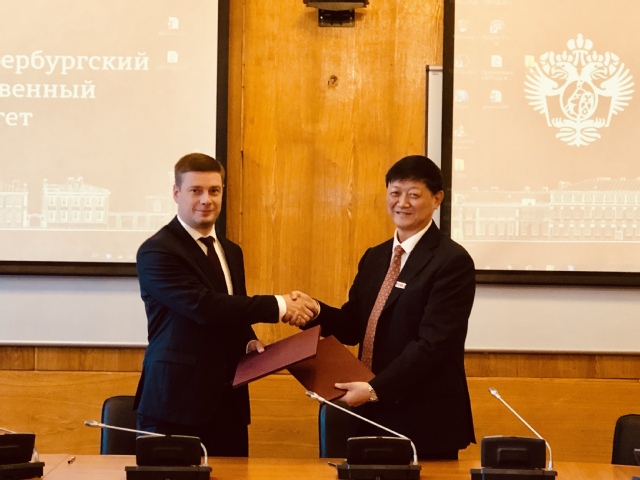
Pic3. The Signing of the Cooperation Framework Agreement
The two sides signed the cooperation framework agreement at the meeting.
Afterwards, accompanied by Andryushin, the delegation visited the Mendeleev Archives and the university’s library.
Visiting Hebrew University of Jerusalem: Planning to Co-Found a New College
On the afternoon of October 27, Hu and the rest of the delegation visited the Hebrew University of Jerusalem and held in-depth discussions with the host on the promotion of the university-level strategic cooperation.
The Hebrew University of Jerusalem’s rector Asher Cohen and vice rector of foreign affairs Oron Shagrir warmly received the delegation.
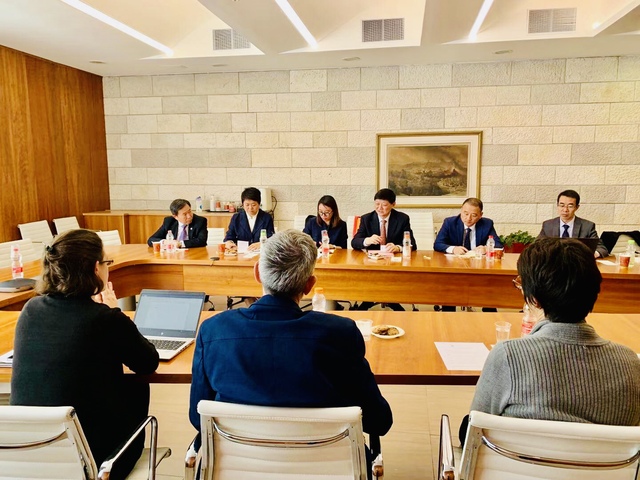
Pic4. Discussions at Hebrew University of Jerusalem
During the discussions, Hu briefed the general development of Nanjing University and reviewed the long-term cooperation between the two universities in the fields of atmospheric science, Jewish studies, and chemistry. He hoped to further deepen the existing cooperation and expand it into artificial intelligence, computer science and new material.
Hu suggested establishing a new NJU-Hebrew University of Jerusalem college so as to strengthen the bilateral cooperation in research, talent training and culture inheritance.
Cohen agreed with Hu and said that Israel is an innovation-based country that focuses on innovation and development. The Hebrew University of Jerusalem has long been committed to promoting the internationalized development, especially development with partners in China.
He said that he will vigorously promote bilateral cooperation in the fields of natural sciences, humanities, social sciences and physics.
The two sides signed a cooperation framework agreement at the meeting.
Visiting Israel Institute of Technology: Planning to Co-Found a New College
On the afternoon of October 28, Hu and the rest of the delegation visited Israel Institute of Technology. They were warmly received by Oded Rabinovitch, executive vice president of academic affairs, Jacob Rubinstein, vice president for research, and Alon Wolf, vice president for external relations and resource development.
The two sides conducted in-depth discussions on the promotion of the school-level strategic cooperation.
During the discussions, Hu briefed the general development situation of Nanjing University and reviewed the two universities’ long cooperation and fruitful achievements in the urban planning discipline. The two universities jointly built the “China-Israel Planning Innovation Center.” He said that Jiangsu is known for its innovation and now its economic development calls for high levels of scientific and technological innovation.
Hu hoped that Nanjing University will strengthen the cooperation with the Israeli Institute of Technology in innovation, in jointly cultivating students, and in conversion of research achievements, and he hoped to increase the influence of the Israeli Institute of Technology on innovation education.
Hu proposed to establish in Jiangsu a new college jointly with the Israeli Institute of Technology, a college that focuses on artificial intelligence, new materials, new energy, chemistry and other strong disciplines. Through working together in cultivating innovative talents and promoting the transference of results and social services so as to upgrade the cooperation between the two universities to a new stage.
Rabinovich expressed the Israeli university’s willingness to actively promote exchange and cooperation between the two universities in research, student exchange, faculty visit and master’s- and Ph.D. level training so as to continuously deepen and expand the down-to-earth cooperation.
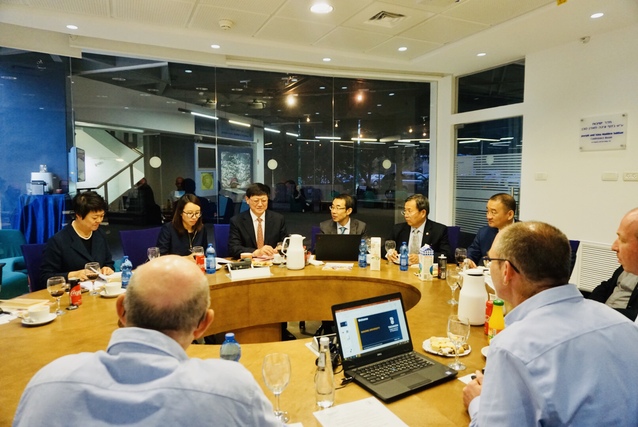
Pic.5 Discussions at Israel Institute of Technology
The two sides signed a cooperation framework agreement at the meeting.
During the visit, the delegation also went to the hosting university’s Department of Architecture and Urban Planning for in-depth discussions.
Visiting University of Bar-Ilan: Expanding Multidisciplinary Cooperation
On the afternoon of October 28, Hu and the rest of the delegation visited Bar-Ilan University and exchanged views on further cooperation with the hosting university.
Vice president Moshe Lewenstein and vice president of research Shula Michaeli warmly received the delegation. They also conveyed the welcome greetings from senior president Arie Zaban, who went on a business trip in the last minute.
During the discussion, Hu reviewed Nanjing University Jewish and Israeli Institute’s long exchange and cooperation with Bar-Ilan University, which he saw as having resulted in profound friendship.
Based on the achievement, Hu hoped that two universities can expand their cooperation to their strong disciplines such as quantum science, quantum communication, computer science and brain science so that they can further enhance the bilateral cooperation in research, talent training and culture inheritance.
Lewenstein said that Nanjing University is the most important partner of his university and he and his colleagues will continue to promote bilateral cooperation to make fresh achievements.
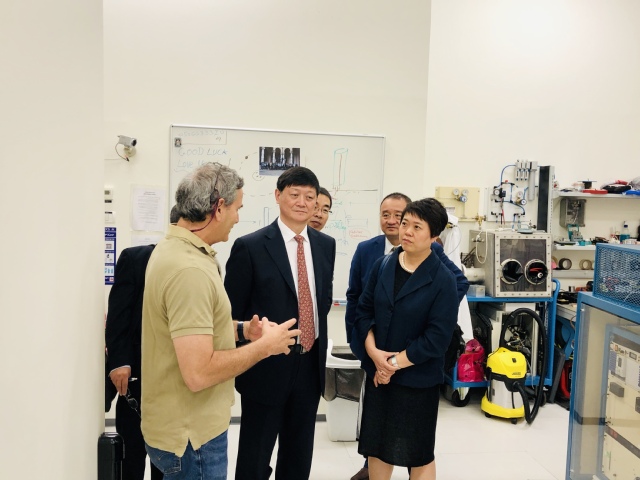
Pic6. Hu and the rest of the delegation visit Bar-Ilan University’s Nanometer Center.
At the meeting, the two sides signed a cooperation framework agreement.
Later, the delegation went to the Jewish Research Institute of Bar-Ilan University for discussion and also went to the nanotechnology center.
During the visit to Russia and Israel, Hu and the rest of the delegation visited Ambassador Zhang Hanhui, Minister councilor Cao Shihai and Ambassador Zhan Yongxin at the Chinese Embassies to Russia and to Israel, respectively, to gain mutual understanding with people of various circles in Russia and Israel and exchange ideas of future cooperation.
The delegation also went to Tel Aviv’s city government for discussions and learning about Tel Aviv’s smart city construction and innovation achievements in order to promote exchange and cooperation in innovation between China and Israel.

Pic7. Hu and the rest of the delegation visit Tel Aviv’s city government.
The delegation included leaders of the School of Foreign Studies’ Russian Department, the Jewish and Israeli Institute, Office of the CPC Committee, and the International Office.

