

The research team from the College of Engineering and Applied Science of Nanjing University (NJU) has achieved a major breakthrough in building what is known as all-perovskite tandem solar modules, a development so important that it was reported in one of the world’s top journal Science.
The team, led by Professor Tan Hairen, built the new modules by using scalable production techniques such as blade-coating and vacuum deposition.
It has blazed a new path to scalable fabrication and commercialization of large-area all-perovskite tandem solar modules.
As certified by an internationally authoritative third-party measurement institute, the steady-state power conversion efficiency (PCE) of the large-area module is as high as 21.7%, the highest efficiency of perovskite solar modules in the world, and this result was included in the latest issue of the Solar Cell Efficiency Tables.
The study of Professor Tan’s team was published in the world’s top-notch journal Science on May 13, 2022, under the title “Scalable Processing for Realizing 21.7%-efficient All-Perovskite Tandem Solar Modules” (https://www. science.org/doi/10.1126/science.abn7696).
Tan’s team has been dedicated to the fundamental and applied research on new high-efficiency solar cells in order to serve China’s grand strategy of “peak carbon dioxide emissions and carbon neutrality.”
Over the years, the team has carried out systematic and in-depth research in the international frontline topic of “all-perovskite tandem solar cells.”
The team proposed a new tunnel junction structure, thus marking a breakthrough in the fabrication of all-perovskite tandems and shedding light on a new strategy of improving the surface defect passivation of perovskite grains.
The term therefore achieved a world record of 26.4% efficiency for all-perovskite tandem solar cells, which surpassed the highest certified efficiency for single-junction perovskite solar cells in the world (see Nature, 2022, 603, 73-78; Nature Energy, 2020, 5, 870-880; Nature Energy, 2019, 4, 864-873).
Although small-area perovskite solar cells in the laboratory have achieved high efficiency, the commercialization of large-area perovskite solar modules still faces many challenges, among which the scalable fabrication and long-term stability of the interconnected structures in the modules were major bottlenecks.
To achieve scalable fabrication of all-perovskite tandem solar modules, the team should first solve the problem of fabricating a large-area uniform wide-bandgap perovskite film.
Although great progress has been made in the large-scale fabrication of conventional bandgap perovskites, the technology is hardly applicable to wide-bandgap perovskites since it contains high concentration of bromide. So, the choice of solvents is limited by the low solubility of bromide in the wide-bandgap perovskites; The crystallization is also difficult to modulate to obtain high-quality uniform and dense films for wide-bandgap perovskite. It is almost void of the research on its scalable fabrication technology in the world.
In response to these challenges, Tan’s team proposed to make all-perovskite tandem solar cells by adopting blade-coating and vacuum deposition, instead of the common laboratory processing of spin-coating, to achieve the scalable fabrication of all-perovskite tandem solar cells.
To tackle the problem of crystallization in the coating process of wide-bandgap perovskites, the team adjusted the Cs content of the cation in the perovskite (CsxFA1-xPbI1.8Br1.2) and coupled it with gas blowing, and thus effectively modulated the nucleation and crystallization process of wide-bandgap perovskites.
It revealed the influence of Cs content on perovskite film formation, and achieved the scalable fabrication of wide-bandgap perovskites by blade-coating (Fig. 1).
The team also found that increasing the content of Cs could effectively accelerate the nucleation and crystallization of the perovskite. Moreover, by adjusting its content to 35% (i.e., Cs0.35FA0.65PbI1.8Br1.2), the team can obtain a flat and dense perovskite film with the best crystallinity. This finding laid a solid foundation for the scalable fabrication of all-perovskite tandem solar modules.
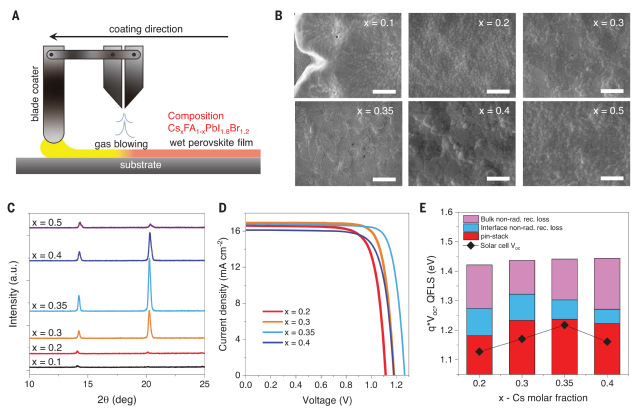
Fig. 1. Fabrication of wide-bandgap perovskite films using gas-assisted blade coating. (A) Schematic illustration of gas-assisted blade coating. (B-E) Characteristics of perovskite films and performance of perovskite solar cells with different Cs contents.
In series-connected perovskite solar modules, there is a complex interconnection structure of each two sub-cells. Due to the direct contact between the perovskite light-absorbing layers and the back metal electrode in this interconnection structure, the interdiffusion between the halogen ions in perovskites and the metal happens, leading to the corrosion of the electrode and the degradation of the perovskites.
To deal with the interdiffusion in the interconnection area, the team intelligently used atomic layer deposition (ALD) to prepare a dense SnO2 electron transport layer (ALD-SnO2), which could be deposited conformally in the interconnection areas of subcells and effectively avoid the direct contact between perovskites and electrode in the interconnect structure (see Fig. 2A).
In addition, the ALD-SnO2 layer is sufficiently conductive as it does not affect the ohmic contact between the metal electrode and the transparent conducting oxide electrode on the front surface in the interconnect areas.
The conductive and conformal barrier layer serves as an electron transport layer in the active area of each subcell, validly blocking ion migration and diffusion of metal electrodes, preventing the oxidation of the narrow-bandgap perovskite, enabling operations such as the scribing, measurement and encapsulation of modules under atmospheric conditions.
Based on such innovative module structure design, the fabrication repeatability, photovoltaic performance and stability of the module are significantly improved. The efficiency of the large-area tandem module in laboratory tests reached 22.5%, and the steady-state efficiency certified by JET reached 21.7%, which is the highest reported efficiency for perovskite solar modules in the world.
This was included in the latest issue of Solar Cell Efficiency Tables (Version 59) (Fig. 3). One referee commented, “I believe this work represents a significant milestone towards highly efficient, stable, and cost-effective solar modules fully using scalable fabrication techniques.”
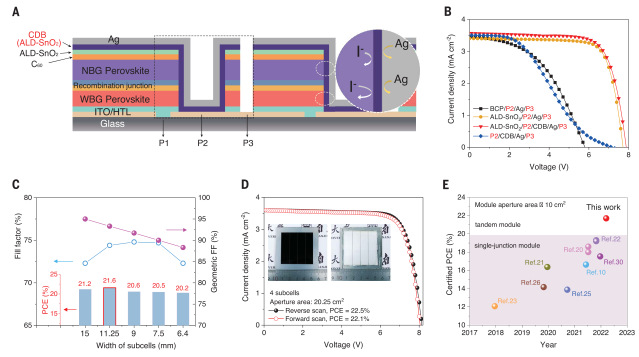
Fig. 2. All-perovskite tandem solar modules. (A) Configuration schematic of an all-perovskite tandem solar module with the conformal diffusion barrier (ALD-SnO2). (B-D) Photovoltaic performance of all-perovskite tandem solar modules. (E) Summary of publicly reported, independently certified efficiencies of perovskite solar modules.

Fig. 3. Tandem solar cell efficiency table (Version 59).
Ke Xiao, a PhD student at NJU, is the first author of the Science paper, and Professor Hairen Tan, of NJU’s College of Engineering and Applied Science, and Professor Henry J. Snaith, of the University of Oxford, are the co-corresponding authors.
This research was supported and advised by Professor Jun Xu, of Nanjing University, and Professor Yi Hou, of National University of Singapore.
It was funded by the National Natural Science Foundation of China, the Frontier Science Center of the Ministry of Education, and the Natural Science Foundation of Jiangsu Province, and it was also supported by the National Laboratory of Solid State Microstructures, Nanjing University, and the Frontiers Science Center for Critical Earth Material Cycling of Ministry of Education, Nanjing University.

