

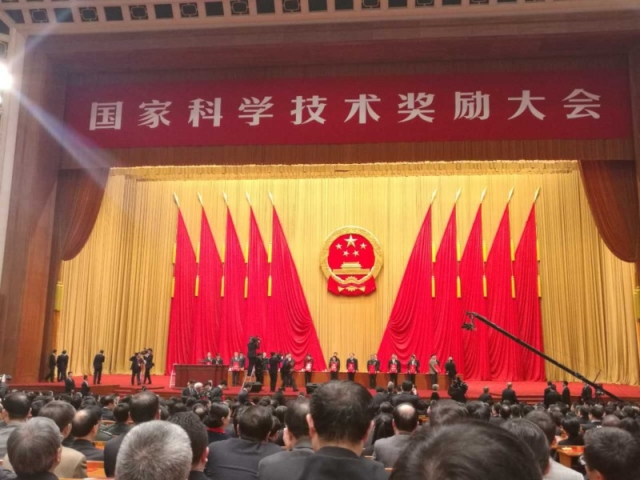
Nanjing University made a good show at the ceremony for the 2016 National Science and Technology Award held on January 9 in the People’s Great Hall in Beijing in the presence of Xi Jinping and other senior government leaders. China in total awarded 2 National Highest Science and Technology Awards, 42 National Natural Science Awards, 66 National Technological Invention Awards and 171 National Science and Technology Progress Awards.
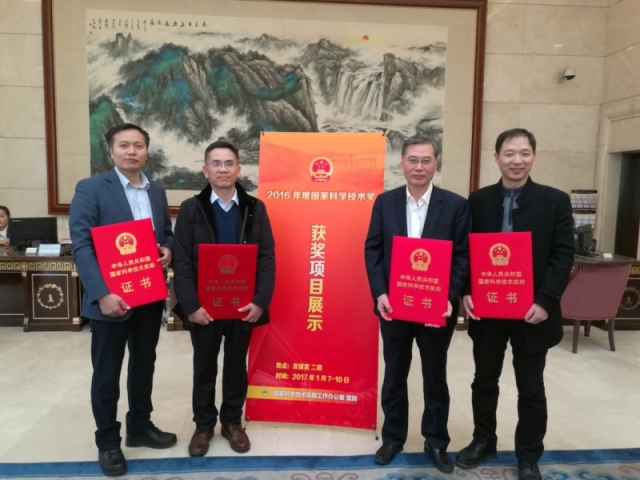
Nanjing University won one second prize of the National Natural Science Award, one second prize of the National Technological Invention Award, and two second prizes of the National Science and Technology Progress Award, ranking the fifth of the universities in China.
The team led by Professor Zhang Xuxiang, School of the Environment, won a second prize of the National Natural Science Award for their program “Basic Studies on the Group Recognition and Prevention Control of the Danger on Environment Caused by HRPs.” With its multiple variety, high toxicity and complex poisoning mechanism, HRPS may impose great harm on human body and environment even in small doses, and it is therefore listed by UNEP as an environmental problem that should be urgently dealt with through global cooperation.
Over a period of 17 years, Professor Zhang’s team developed a new biological group method for accurate identification of the harms to health caused by HRPs. This became the basic method for rapid identification and preventive control of HRPs’ harms. The team discovered the control mechanisms for such harms and laid a theoretical foundation for a comprehensive understanding of the danger of HRPs. The team worked on the features and control technology of HRPs so as to provide our country with support for preventing and controlling the risks of HRPs. The team has published 120 SCI papers, 20 of which were cited for 1,229 times.
The team led by Professor Zhang Rong, School of Electronic Science and Engineering, won the second prize of the State Technological Invention Award for its “advanced solar-blind UV detection and application technology.” To meet the national strategic demand for solar-blind UV detection, the team has focused on the research and development of materials, devices and imaging of nitride semiconductor UV detection. It solved such problems as signal enhancement within the band of the detector and noise suppression outside the band of the detector. It developed, among others, heterogeneous interfacial stress regulation and parasitic reaction suppression technology, achieving the preparation of high quality solar-blind wave band AlGaN material. It invented the polarization enhanced solar-blind UV detectors, expanding a new horizon in highly sensitive UV detectors. It developed single photon sensitivity UV imaging technology for solar-blind, and this broke down the embargo imposed upon us and filled the gaps in the field for the country. The technology is used in monitoring and warning systems for grid security. The team also created high precision UV positioning and navigation technology at the decimeter level. It for the first time developed a navigation system for ships to moor alongside in fogs, exploring a new area of solar-blind UV navigation.
The team has published 65 academic papers and has been granted 30 invention patents. The results of its research have been put into volume production, generating economic benefits of several hundred million yuan in total over the past three years.
The team led by Professor Li Aimin, School of the Environment, won the second prize of the National Science and Technology Progress Award for its project: “key technologies and equipment for degradation-resistant organic industrial wastewater treatment and toxic emission reduction.” Focusing on the treatment and toxic emission reduction of degradation-resistant organic industrial wastewater, the team independently developed recycling, efficient conversion and efficient purification techniques for degradation-resistant organic pollutants. It has been granted 30 patents at home and abroad, the first prize of the Science and Technology Award of Jiangsu Province, the China's outstanding patent award, and the national key new products award.
The technology the team developed has helped build 89 sewage treatment plants in several provinces and helped purify about 194 million tons of wastewater in the past three years, reducing COD (Chemical Oxygen Demand) by about 374 thousand tons. The team has made great contributions to the effective control of toxic, organic pollutants in major river basins of the country and in the coastal industrial parks of Jiangsu Province, to the sustainable development of key industries and to the provision of clean drinking water.
The project “The Development and Application of Disease Models in Genetic Engineering” conducted by Professor Gao Xiang and his team, of Model Animal Research Center, was awarded the second prize of the National Science and Technology Progress Award.
The research belongs to the area of pharmaceutical and biomedical engineering. The team has made major breakthroughs in the development and analysis of animal models, improving the technology of gene-editing and pushing the frontiers in the area of gene knockout mice in our country. The team has firstly developed the model of gene knockout dogs in the international stage and has provided support for two of China’s major scientific breakthroughs. It has also built a world-class research center of mouse models and has provided support for thousands of institutes in research and development of bio-medicine, making both economic and social benefits. The team has also made contributions to the establishment of International Mouse Phenotyping Consortium(IMPC), improving China’s international standing and influence in the area of animal models.
The team members have published over 50 papers as corresponding authors in SCI journals and are highly praised by international counterparts.
In the recently published list of University and College Scientific and Technology Awards, 15 projects conducted by Nanjing University were on the list. The university ranks at the top in terms of the number of awarded projects. Over the past few years, the university has made effective reform in its science and technology system, encouraging professors and researchers to conduct original research that is aimed at pushing the international academic frontiers and research that is aimed at meeting major national needs. The reform has made great contributions to turning the university into one of the world class.

