

A significant breakthrough on all-inorganic perovskite solar cells has been made by the Micro-Nano Material Study Group, under the leadership of professors Jin Zhong and Liu Jie, from School of Chemistry and Chemical Engineering, Nanjing University.
The findings of the team were published in Journal of the American Chemical Society, 2016, by the title “All-Inorganic Perovskite Solar Cells.” Doctor Liang Jia, assistant researcher in the group, is the first author.
Over the few years since the application of organic-inorganic perovskite to solar cells in 2009, the photovoltaic conversion efficiency of the perovskite solar cells (PSCs) has risen from the initial 3% to the present 22%. Efficient as they are, however, they exhibit poor stability due to the fact that the material of halide perovskites is highly susceptible to decomposition under moisture and heat.
Some organic additives in commonly-used hole transport materials (HTMs), such as lithium (trifluoromethylsulfonyl), imide and tert-butylpyridine, are also hygroscopic and deliquescent and result in performance degradation.
Moreover, the fabrication of hybrid PSCs still relies on precise environmental control, such as gloveboxs or dryrooms, and this adds to the difficulty and costs to its application. To find cheap alternatives for replacing expensive organic HTMs and noble metal electrodes has come to the fore.
In order to find solutions, the study group led by Professors Jin and Liu, for the first time in the field of research, proposed to produce the perovskite solar cells made of inorganic materials, that is, eliminating all unstable organic components as in the traditional inorganic-organic hybrid perovskite solar cells (Figure 1).
Even without encapsulation, the all-inorganic PSCs demonstrate high stability and present no performance degradation in humid air (90−95% relative humidity, 25°C) for over 3 months (2,640 h) and can endure extreme temperatures (100° and −22°C) (Figure 2).
Moreover, with the elimination of expensive HTMs and noble-metal electrodes, the cost was significantly reduced by the use of cheap carbon electrodes. This study has opened the door for the next-generation PSCs with long-term stability under harsh conditions, making practical application of PSCs a real possibility.
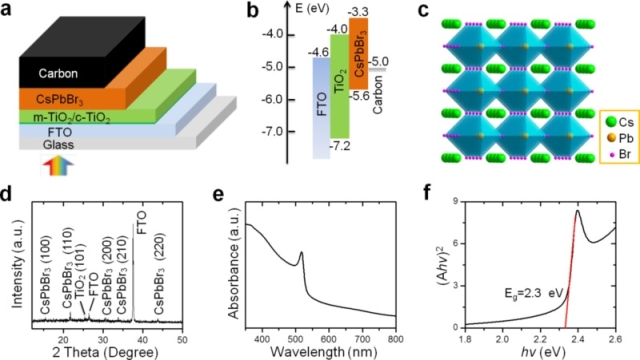
Figure 1. (a) Schematic cross-sectional view of CsPbBr3/carbon-based all-inorganic PSCs with the configuration of FTO/c-TiO2/m-TiO2/CsPbBr3/carbon. (b) Energy level diagram of the all-inorganic PSCs, showing smooth electron injection and hole extraction. (c) Crystal structure of the inorganic perovskite CsPbBr3. (d) XRD pattern of the all-inorganic PSCs without the carbon layer, showing peaks generated by CsPbBr3, FTO, and TiO2. (e) Absorption spectrum and (f) corresponding (Ahv)2vs energy (hv) curve of a CsPbBr3 film. The optical band gap of CsPbBr3 was measured to be ∼2.3 eV.
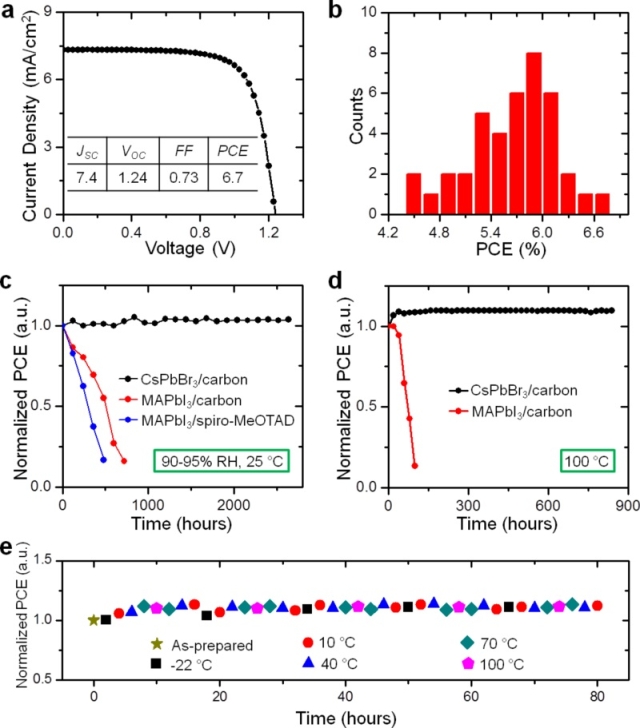
Figure 2. (a) J−V plot of CsPbBr3/carbon-based all-inorganic PSCs. The inset shows the corresponding photovoltaic parameters. (b) Statistical histogram of the PCEs of 40 individual CsPbBr3/carbon based all-inorganic PSCs. (c) Normalized PCEs of CsPbBr3/carbon based all-inorganic PSCs and MAPbI3/carbon-based and MAPbI3/spiro-MeOTAD-based hybrid PSCs as a function of storage time in humid air (90−95% RH, 25°C) without encapsulation. (d) Normalized PCEs of CsPbBr3/carbon-based all-inorganic PSCs and MAPbI3/carbon-based hybrid PSCs as a function of time heated at high temperature (100°C) in a high-humidity ambient environment (90−95% RH, 25°C) without encapsulation. (e) Normalized PCEs of CsPbBr3/carbon-based all-inorganic PSCs vs storage time during temperature cycles (between −22 and 100°C) in a high-humidity ambient environment (90−95% RH, 25°C) without encapsulation.
The project was sponsored by the Global Experts Program, 973 Project, Key Research and Development Program, the Natural Science Foundation of China and the Natural Science Foundation of Jiangsu Province.
(School of Chemistry and Chemical Engineering & Scientific and Technology Office)

