

The CPC and state leaders Xi Jinping, Li Keqiang, Zhang Gaoli and Wang Huning presented awards at the 2017 State Science and Technology Award ceremony, held in the Great Hall of the People in Beijing on January 8, 2018.
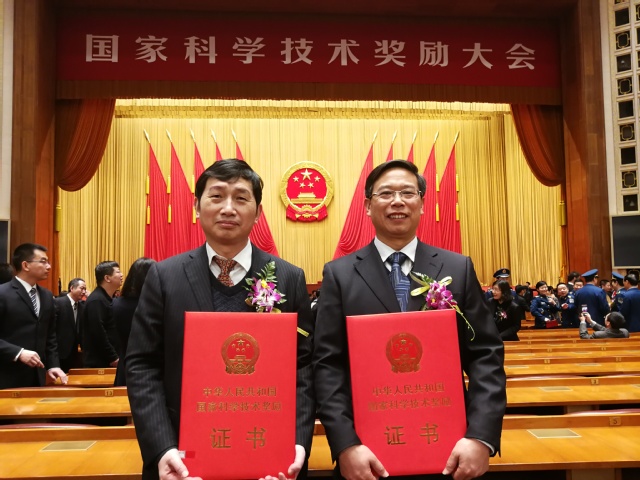
The awards presented included two State Top Science Awards, 35 State Natural Science Awards, 66 State Technological Invention Awards and 170 National Awards for Science and Technology Progress.
Two of the research achievements from Nanjing University won the second prizes of the State Natural Science Award, making the university one of those top winners of Natural Science Awards nationwide.
The team of research on “the formation of Cenozoic granitoid and continental crust evolution in Cathaysia Massif” won a second prize of the State Natural Science Award, and the team was headed by Professor Zhou Xinming, School of Earth Sciences and Engineering, Nanjing University.
The team selected Cathaysia Massif as the focus of study because it has the densest granite with the most complex formation of all. The study was the first in exposing the relationship between Tethys domain in Indo-China diastrophism and Pacific tectonism. It established a new model of the reduction and extension of the formation of Cenozoic granitoid and volcanic rock. It identified the main provenance and heat reservoir of the formation of Cenozoic granitoid and revealed the heat mineralization regularity of rare metal granite magma.
The project team published eight major papers, which have been cited for more than 1,400 times by other SCI papers. Its achievement has important significance in the research on the formation of global granite and continental crust evolution.
The team of basic research on “Surface and Interfacial Regulation of Several Low Dimensional Semiconductors and Relevant Devices,” led by Professor Shi Yi from, School of Electronic Science and Engineering, Nanjing University, won another second prize of the State Natural Science Award.
This project explores issues on structure-activity relationship between nanostructures and devices, and it has revealed the pervasive principle of nanomaterial processing, proposing new ideas for regulating the surface/interface electronic state of nanostructures to enhance the performance of devices. It has also developed the new devices which go beyond the conventional performance limits.
The major achievements of the team include:
(1) proposing a method for the processing of one-dimensional nanomaterials based on new principles of self-dissolving template method and nano stress cleavage;
(2) revealing the effects and regulation mechanisms of two-dimensional crystal surface/interfacial state on carrier transport; and
(3) discovering the multi-channel coupling effect of semiconductor hydrogel charge transport, which solves the core problem of interface signal transmission in multidimensional heterogeneous nano-devices.
The project team published a total of 236 SCI papers, eight of which have been cited for more than 1,100 times by other SCI papers. Part of the project’s achievements also won the first prize of 2016 Jiangsu Provincial Science and Technology Award.
Since the reform of the national science and technology awards system in 1999, Nanjing University has won, as the first project holder, 38 national science and technology awards, covering a wide variety of disciplines, reflecting the advantages and characteristics of Nanjing University as a comprehensive, research-oriented university.

