

Five of Nanjing University’s teaching projects were awarded first prizes at the Conference of 2019 Teachers Day Celebration and Commendation of Advanced National Educational Collectives and Individuals, held in Beijing on September 10, 2019, the 35th Teachers Day of the country.
Altogether, the conference awarded 1,355 “National-Level Teaching Achievement Prizes,” and among all the award-winning universities in the country, Nanjing University won the largest number of first prizes.
Representatives of the five projects went to the conference and received the prizes at the Great Hall of the People.
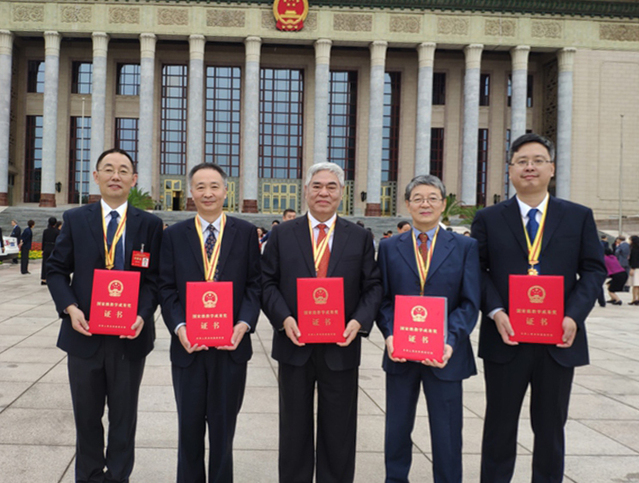
Representatives of the five projects received the awards in Beijing.
The National-Level Teaching Achievement Prizes are announced every four years, including three categories of basic education, vocational education, and higher education. They demonstrate the achievement in schools’ talent cultivation and educational reform.
In the selection of the 2018 National-Level Higher Education Teaching Achievement Prizes, Nanjing University had nine projects win prizes as an independent completing unit and two projects win prizes as a cooperating unit.
Among these projects, five were awarded first prizes, that is, “Innovation and Practice of an Inter-Cultural Competence Training System for High-Quality Foreign Language Talents,” “the Pleasant Classics Reading Program: New Educational Practice for Rekindling College Students’ Reading Culture,” “Construction of Clustered Political Economics Courses of Socialism with Chinese Characteristics,” “Construction and Practice of Hi-Tech Innovation Capacity Training Mechanisms for University Chemistry Majors,” and “Exploration and Practice of Innovation and Entrepreneurship Education Reforms in Comprehensive Universities.”
Nanjing University’s number of first prizes ranked first of all universities in the country, accounting for 10 per cent of the first prizes set in 2018 National-Level Teaching Achievement Prizes for Higher Education.
These awards show the university’s achievements in educational reform and cultivation of innovative talents. It also illustrates the university’s efforts to offer “the best undergraduate education.”
(Office of Academic Affairs)

