

The “Lobster-Eye X-ray Satellite,” independently developed by Nanjing University, was successfully launched on July 25 into the preset orbit at the Taiyuan Launch Center, riding the Long March 4B lift rocket.
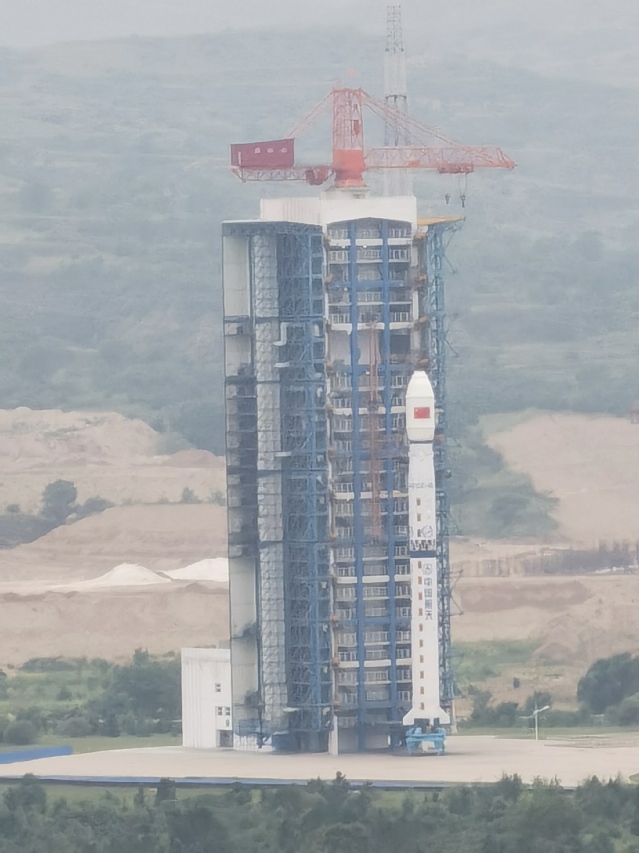
The Launch Site
The satellite was designed and built by a joint team led by Nanjing University’s School of Astronomy and Space Science.
The successful launch was the outcome of joint efforts over the past five years by all these outstanding scholars of space science and space exploration.
The satellite is equipped with an internally developed “Lobster-Eye,” which consists of an X-ray detector and a small high-precision payload platform.
During the satellite’s long-term operation on the orbit, the “Lobster-Eye” will verify the ultra-large X-ray field-of-view within the X-ray energy regime and complete several important space X-ray detection experiments, especially carrying out research on in-depth dark matter signal detection within the X-ray energy regime.
The X-ray imaging technology, like the way a lobster eye focuses light, was first proposed in the 1970s. It is suitable for space payload applications with its advantages of large field-of-view, small size, light weight, and easy assembly.
The “Lobster-Eye X-ray Satellite” is the world’s first in-orbit space exploration satellite equipped with the “Lobster-Eye” focused X-ray imaging technology.
Its core payload was technically guided by Nanjing University and jointly researched and jointly developed by 508 Institute of CASC and China Building Materials Academy (CBMA).
Professor Li Zhiyuan from the School of Astronomy and Space Science of Nanjing University and Professor Su Meng from the Laboratory for Space Research (LSR) of The University of Hong Kong jointly initiated this project.
On the basis of the collaboration on this satellite and the upcoming series of satellites, these participating research institutions will carry out full-chain and systematic work in basic research and engineering applications.
They will make more efforts at core payload technology breakthroughs, promote the transformation of advanced scientific and technological achievements into new instruments and equipment, and enhance our nation’s independent innovation capabilities in space astronomy, deep space exploration and space remote sensing fields.

