

Nanjing University’s solid microstructure lab’s research breakthrough in quantum optical sources made its way into the latest, June 26 issue of top international journal Science (https://science.sciencemag.org/content/368/6498/1487).
The new, metalens-array-based high-dimensional and multi-photon quantum source was developed by Wang Shuming, Zhang Lijian ,Wang Zhenlin, and Zhu Shining from the university’s National Laboratory of Solid State Microstructures (NLSSM) and their collaborators, and Science has carried the paper the NJU team wrote of its research.
Quantum information is one of the most cutting-edge and active research fields in the world. With the development of photonic quantum information technology, the requirement for both entanglement dimensionality and photon number increases.
However, the existing entangled quantum photonic sources based on nonlinear optical processes have such problems as complex optical systems, low integration and weak stability and therefore fail to meet the demands for large dimensionality and multiphotons for practical applications in fields of quantum communication, quantum computation, and quantum metrology. The problems have restrained the advance of photonic quantum information processing towards large-scale integration.
Recently, the research progress in “metasurface,” an ultrathin microstructured film material, has provided a brand-new path for the development of quantum photonic sources and photonic quantum information technology.
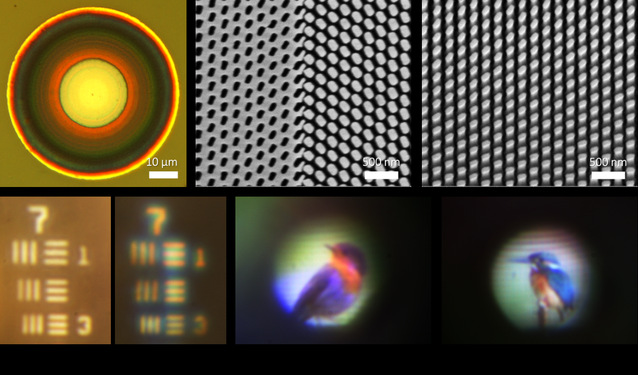
Figure 1. Imaging using a visible achromatic metalens
The NLSSM team led by Academician Zhu Shining and Professor Wang Zhenlin has long been dedicated to research on optical metamaterials and metasurfaces. Recently, Associate Professor Wang Shuming, Professor Li Tao and other team members have made a series of achievements in metalenses designing and imaging.
They put forth a principle of phase separation to eliminate chromatic aberration in lens-imaging by using metasurface materials, and designed a broadband achromatic metalens working in the visible light region and contributing to forming images by the achromatic and chromatic metalenses (see Figure 1).
To this day, this remains the only successful case reported internationally of forming full-color images by using metasurfaces (see Nat. Nanotechnol. 14, 227-231 (2019);Nat. Nanotechnol. 13, 227-232 (2018);Nat. Commun. 8, 187 (2017)).
In this work, the team brought together the expertise on both metasurface and quantum optics to build up a brand-new quantum photonic source that combined a metalens array with a nonlinear crystal (BBO, short for BaB2O4). They designed a 10*10 metalens array, used the pump laser for the array, and so formed a 10*10 array of focal spots inside the BBO crystal.
With these measures, the pump light in the BBO triggered the spontaneous down-conversion to generate an array of signal/idler photon pairs. In principle, the device could generate 100-dimensional path-entangled photon pairs. It was found that entangled photons could achieve higher dimensionality as the number of metalens arrays increases.
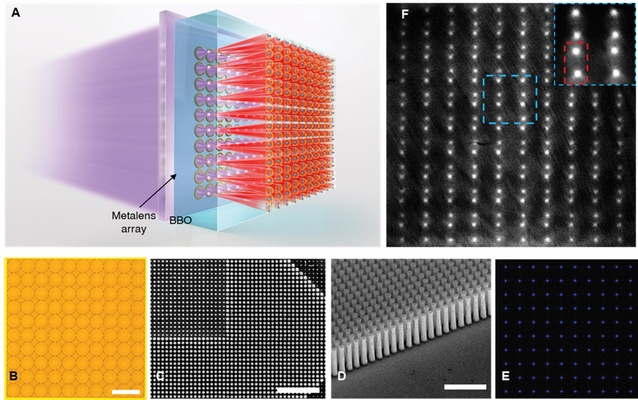
Figure 2. Metalens-array-based quantum source system
In the experiment, the team used a continuous laser with a wavelength of 404 nm as the pump light and measured the entanglement properties among the photons generated by different metalenses in the array.As shown in Figure 3, the measured fidelities to two-, three- and four-dimensional maximally path entanglement were 98.4, 96.6, and 95.0%, respectively.
In addition, the metalens could flexibly manipulate the optical field and thus take an integrated control of the phase, polarization, and amplitude of the optical field, thereby further modulating the entanglement states. In this work, the team precisely encoded the phase of the entangled states through the design of metalenses with different phases, and this was well demonstrated in the experiment.
Moreover, this system can also be used to prepare simple compact multiphoton sources. By introducing a 415-nm femtosecond laser as the pump light into the experiments, the team respectively measured the coincidence curves of the 4- and 6-photons prepared by this system and showed the results of heralded Hong-Ou-Mandel interference, and the results yielded high interference visibility and verified the good performance of the multiphoton quantum sources.
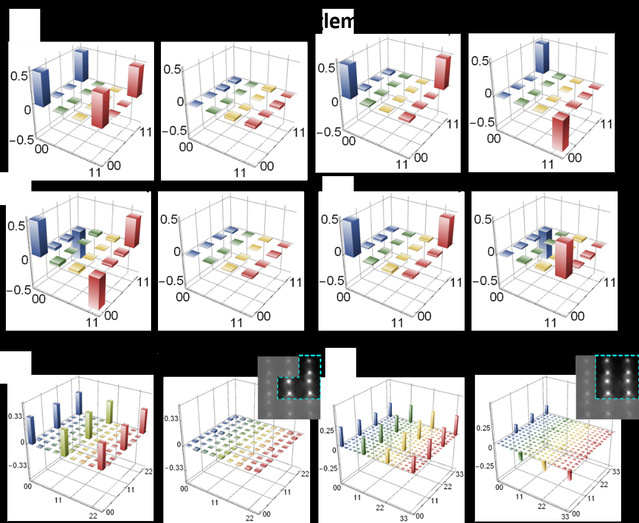
Figure 3. Characterization of prepared entangled quantum states with higher dimensions
By introducing the metasurface technology, an emerging research field, into quantum information, the team has successfully developed high-dimensional, integrated two- and multi-photon entangled sources, overcome the technological bottleneck of quantum photonic sources and broken through the dimensional limitations of current information coding.
Findings of this research are expected to be applied to such fields as high-dimensional quantum communication, quantum computation and quantum storage and therefore are of great significance in developing quantum information technology with higher message-carrying capacity and greater information security.
Most members of the team came from the university’s School of Physics and College of Engineering and Applied Sciences, and so Nanjing University is the first author affiliation.
Co-first authors of the paper include Doctor Li Lin (visiting scholar to Nanjing University and research fellow at East China Normal University), Liu Zexuan (doctoral candidate at Nanjing University), Associate Professor Ren Xifeng (University of Science and Technology of China) and Associate Professor Wang Shuming (Nanjing University).
Professor Zhang Lijian, Associate Professor Wang Shuming, Professor Wang Zhenlin and Academician Zhu Shining, all of Nanjing University, and Professor Tsai Din Ping, of The Hong Kong Polytechnic University, are listed as corresponding authors.
The research is supported by National Key R&D Program of China, National Natural Science Foundation of China and Excellence Programs of Nanjing University.

