

Lu Shan, professor of the School of Life Sciences at Nanjing University (NJU), has a research paper titled “A recruiting protein of geranylgeranyl diphosphate synthase controls metabolic flux toward chlorophyll biosynthesis in rice” published online by the Proceedings of the National Academy of Sciences of the United States of America (PNAS) (http://www.pnas.org/content/early/2017/06/07/1705689114) on June 12, 2017. The paper discovered a novel protein, GGPPS Recruit Protein (GRP), in rice that prioritizes the substrate supply for the synthesis of the phytyl side chain of chlorophylls through its interaction with GGPPS, in thylakoids.
A photo of Prof. Lu Shan
Chlorophyll is the most important organic compound, the research of whose synthesis mainly focuses on the metabolism of its tetrapyrrole ring with the supply of its phytyl side chain largely neglected. The phytyl is derived from geranylgeranyl diphosphate (GGPP) in chloroplasts, but meanwhile GGPP also serves as a precursor for the synthesis of other vital essential chemicals such as three groups of plant hormones (gibberellins, abscisic acid, strigolactones) and carotenoids (Fig. 1). These processes occur in different compartments of chloroplasts, e.g., stroma and thylakoids. How plants regulate accurately the supply of GGPP to realize the synthesis of different substances is always a confusing and inevitable problem in many aspects of metabolic manipulation.
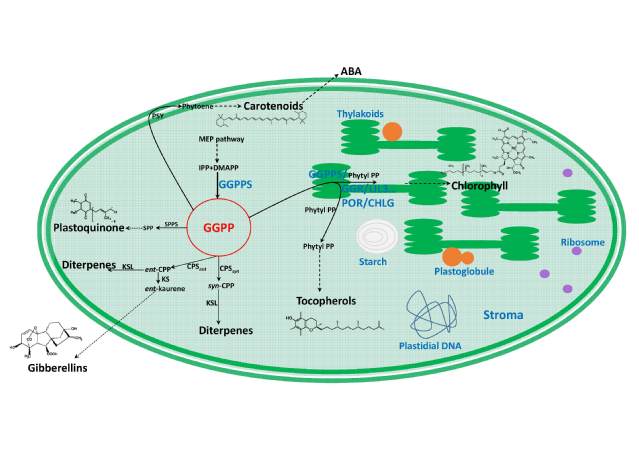
Fig. 1. GGPP in chloroplasts is competed by multiple downstream metabolic branches.
As an intern student in Prof. Lu’s lab, Sun Wenzhu (Class of 2010, Life Sciences), found that plants might have preference in supplying GGPP for different products. Later, Zhou Fei, her undergraduate classmate, spent 6 years working on this result and found that GGPP synthase (GGPPS), the enzyme which produces GGPP, could either form homodimers in the stroma, or heterodimers (with GRP) in thylakoids. Through enzymatic assays and genetic and structural biological studies, it is proved that compared with homodimers, heterodimers have stronger affinity, higher enzymatic activity, and improved catalytic specificity (Fig. 2). Characterization of transgenic plants also demonstrated that rice uses GRP to regulate the distribution of GGPPS between homodimers and heterodimers. And in this way, the distribution of GGPPS in chloroplasts’ stroma and thylakoids and its enzyme activity are regulated. The research further ascertains that chlorophyll biosynthesis relies on the GGPP produced by the GGPPS/GRP heterodimer in thylakoids.
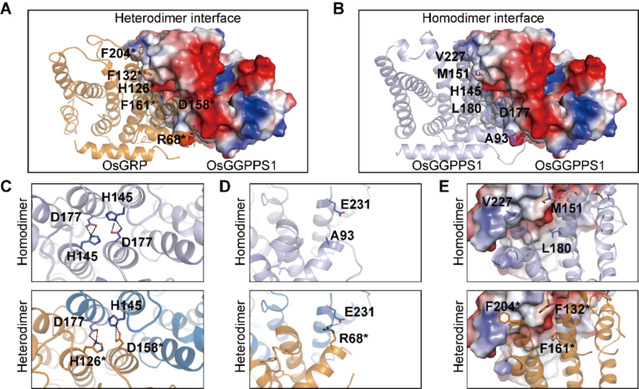
Fig. 2. Rice GGPPS can form homodimers or heterodimers through protein-protein interaction with GRP.
A. Structure of the OsGGPPS1/OsGRP heterodimer showing the amino acid residues at the interfaces.
B. Structure of the OsGGPPS1/OsGGPPS1 homodimer showing the amino acid residues at the interfaces.
C. H145 and D177 in OGGPPS1 are essential for both homo- and heterodimerization.
D. R68* of OsGRP contributes more to the interaction in heterodimers than A93 of OsGGPPS1 in homodimers.
E. F132*, F161*, and F204* of OsGRP contribute more to the interaction in heterodimers than M151, L180, V227 of OsGGPPS1 in homodimers.
“Photosynthesis is the most important chemical reaction on this planet, the key element of which is chlorophyll. This study found a new protein, GRP, in rice chloroplasts. GRP, like a guide, brings the key enzyme to a special structure in chloroplasts, namely thylakoid. As a result, the substrate can be continuously supplied for chlorophyll, and the reaction would not be interfered by other metabolic processes. Cell metabolism is a complex network including many branches with different priorities, but photosynthesis is the main work of chloroplasts. The finding oGRP has well explained the mechanism how plants secure the synthesis of chlorophyll. Since rice is one of the most important cereal crops, this study is also of great importance for crop production”, said Chen Xiaoya, a plant physiologist and CAS academician.

Group members Zhou Fei and Sun Tianhu
The work is supported by National Basic Research Program of China (973 Program), and the collaborators are from four state key laboratories of Nanjing University, Nanjing Agricultural University, Shanghai Jiao Tong University, and Institute of Plant Physiology and Ecology (SIBS, CAS), and from Purdue University. Zhou Fei is the first author and Prof. Lu Shan and Prof. Natalia Dudareva from Purdue University, are the corresponding authors.
(Science and Technology Office and School of Life Sciences, Nanjing University)

