

Nature Reported the Finding of New Class of Ultrathin 2-Dimensional Materials by NJU Scientists
The latest issue of Nature reported the finding of a new class of ultrathin 2D materials of oxide perovskites synthesized by Prof. Nie Yuefeng’s group and characterized by Prof. Wang Peng’s group at Nanjing University. This work also receives the collaborative support from scientists at the University of California, Irvine, and the University of Nebraska–Lincoln.
The title of the paper in the world's leading academic journal reads Freestanding crystalline oxide perovskites down to the monolayer limit.
Given the outstanding electronic properties of oxide perovskites, the breakthrough of the team opens new possibilities in the exploration of quantum behaviors in this new class of strongly correlated two-dimensional materials.
According to Professor Pan Xiaoqing, leader of the international team, since graphene was discovered in 2004, various other kinds of two-dimensional atomic crystal materials have attracted research attention with their diverse physical and chemical properties as well as broad application prospects in the fields of information transmission and energy storage devices.
The two-dimensional materials currently known could be synthesized either by exfoliation or by self-limited chemical vapor deposition owing to the unique layered structures in which many strong covalently bonded planes are held together by weak van der Waals interactions. However, in spite of their rich physical and chemical properties due to electron–electron correlations in the constituent transition-metal ions, oxide perovskites with monolayer thickness are difficult to be synthesized.
In 2016, Harold Hwang's research group at Stanford University developed a new method to synthesize high quality freestanding perovskite oxides by using water-soluble Sr3Al2O6 (SAO) as the sacrificial buffer layer, shedding light on the fabrication of 2D crystals out of vast amount of complex oxides. However, their efforts at making freestanding, monolayer oxide perovskites were not successful.
Instead of the pulsed laser deposition technique used by the Stanford team, Professor Nie Yuefeng's team from Nanjing University used a thin-film growth technique called molecular beam epitaxy, and the team successfully fabricated the two-dimensional material by improving the in-situ growth monitoring technique and adopting a high precision layer-by-layer growth method.
Professor Wang Peng's group, also from Nanjing University, achieved the TEM (transmission electron microscopy) sample preparation, layer determination and fine crystal structure characterization at the monolayer limit using spherical aberration-corrected transmission electron microscopy, and the group directly observed some novel phenomena of BiFeO3 thin films under the reduced dimension.
Such breakthrough was made possible through a careful combination of molecular beam epitaxy and sub-angstrom resolution electron microscopy as well as close cooperation of the researchers.
According to Nie, the way electrons move in a material determines its properties. In traditional two-dimensional materials like graphene, the movement of electrons is nearly free and is not affected by other electrons. In many oxide perovskite materials, however, there is a strong interaction between electrons, which leads to a variety of novel quantum states, including high-temperature superconductivity.
With such new features, Nie explained, the successful fabrication of perovskite two-dimensional materials and the addition of this strong correlation between electrons in the two-dimensional system could enable the exploration of emergent strongly correlated two-dimensional quantum phenomena and applications.
The high-resolution electron microscopy played a crucial role in this project, said Wang Peng, thanks to the rapid development of the spherical aberration-corrected technique and the advanced characterization methods in the last decade.
We believe,” Wang said, “that there will be more interesting and novel physical phenomena waiting for us to explore and discover in this two-dimensional material at the micro scale.
Ji Dianxiang and Cai Songhua, two Ph.D. candidates from the College of Engineering and Applied Sciences, Nanjing University, are the two first authors of this Nature paper, while the three corresponding authors are Professors Nie Yuefeng, Wang Peng and Pan Xiaoqing.
Pan, leader of the joint research group, is Henry Samuel chair professor of UC Irvine and a guest professor of Nanjing University. His team and the team led by Professor E. Y. Tsymbal of the University of Nebraska–Lincoln joined this research project.
The project also received assistance in sample preparation by Associate Professor Gu Zhengbin and in PFM characterization by Professor Wu Di.
This project was sponsored by the National Basic Research Program of China, the National Natural Science Foundation of China, and Jiangsu Provincial Program for High-Level Entrepreneurial and Innovative Talents Introduction.
Also giving support to the project were Nanjing University’s College of Engineering and Applied Sciences, the National Laboratory of Solid State Microstructures, the Collaborative Innovation Center of Advanced Microstructures, and Jiangsu Key Laboratory of Artificial Functional Materials.
In particular, the success of the project has much to do with the encouragement and support late Academician Min Naiben gave to the setup and growth of the Center for Microstructure of Quantum Materials at Nanjing University.
The center was officially launched in 2016, and it focuses on the study of the microstructure and physical properties of quantum materials and the development of next-generation functional materials and devices. (Science & Technology Division, School News Center)
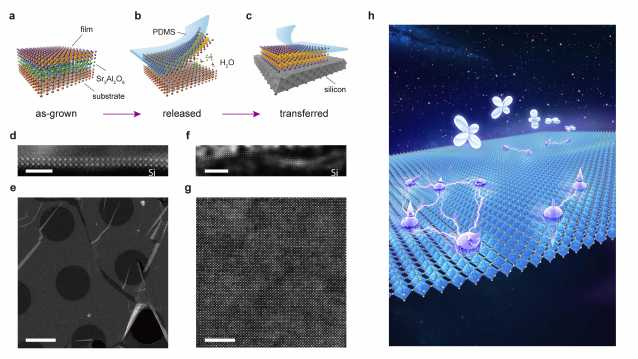
(a-c) Schematic of the growth and transfer of two-dimensional thin films of oxide perovskites;
(d-g) Sub-angstrom resolution structure characterization along different crystal orientations;
(h) Prospective quantum behaviors in strongly correlated two-dimensional oxide perovskite materials

