

A special concert celebrating the 115th anniversary of Nanjing University and the establishment of the Chinese Cultural Research Institute’s National Music Research Center was held in the evening of May 17 at Enling Theater on Xianlin Campus.
Enjoying the concert along with over one thousand of teachers, students, and alumni were Liu Hongjian, vice Chancellor and secretary of the disciplanry committee, Wang Zhilin, vice president of the university, Hou Yong, assistant president, and heads of some departments and schools.
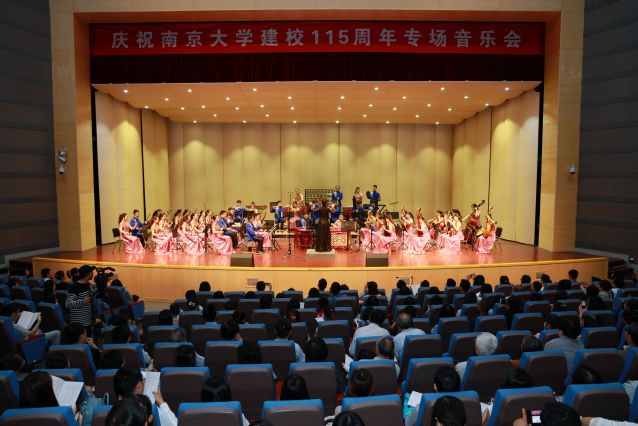
The concert (photo by She Zhijun)
The concert began with the Anthem of Nanjing University, played by NJU’s Chinese Orchestra, to mark the unforgettable 115 years in the past during which generations of the students have stayed true to the original self, creating the priceless spirit of “being simple and glorious, majestic but not flamboyant, even in turbulent years, never obsequious and vulgar, and never going with the stream.”
“Moving the world is the virtue of honesty, as supported by wisdom, courage and benevolence like the Ding sitting on its three feet.” The university’s old anthem echoed in the concert hall, reminding the audience of the fine tradition of “Honesty as the soul, calmness as the strength of character, elegance as the nature, and courage as the persistence.”
The standing conductor of the Chinese Orchestra, Professor Zhang Jingbo, directed the “Harvest Gongs and Drums,” its cheerful melody symbolizing the bumper harvest of the university over the past hundred and fifteen years.
“In spring the river rises as high as the sea, and with the tide of waters the moon uprises bright.” The sextette “A Moonlit Night On The Spring River,” played with traditional stringed and woodwind instruments, created a tranquil and elegant ambiance.
The liuqin solo “Yi River in Spring” brought the audience to the river valley in the brightness of springtime, full of new life and vigor.
The daruan solo “Camel Bells on the Silk Road” showcased the culture in western China, fascinated the audience with the spirit and charm of the Silk Road, and reminded them of the Chinese plans for global peaceful cooperation and collaborative development, which General Secretary Xi Jinping had showed to the whole world just a few days earlier at the Belt and Road Forum for International Cooperation.
Professor Mao Yi from Nanjing University of the Arts, a Guqin player, the inheritor of Guangling School and Zhucheng School, was invited to this concert and played “Three Stanzas of Plum-Blossoms.”
The Guqin performance featured quaint, elegant and scholarly charms, special timbre, deep and ingenious aesthetics and strong artistic expression, which coincides with the charms of scholars of Nanjing University—“the mightiness of Zhongshan Mountain, the deepness of Xuanwu Lake, the magnificence of the Yangtze River, and the bright-coloredness of the Rain Flower.”
The performance of Professor Mao Yi truly intoxicated the audience.
The concert boasted of many brilliant performances and showcased the unique charms of Chinese instruments such as pipa, liuqin, and ruanxian (all three being 4-stringed plucked instruments), qin (a 7-stringed plucked instrument), zheng (a 21- or 25-strined plucked instrument), flute,suona horn, and erhu (a 2-stringed bowed instrument).
The concert gradually reached its climax with such performances as the flute solo “Suzhou Scenery,” guzheng duet “Fighting against Typhoon,”, erhu ensemble “Beautiful New Year’s Eve” and “Horse Race,” ensembles “Dance of Yao Nationality” and “Blooming Flowers,” “Full Moon”, and the classic “Hope Betrayed,” the theme song of “The Story of the Stone.”
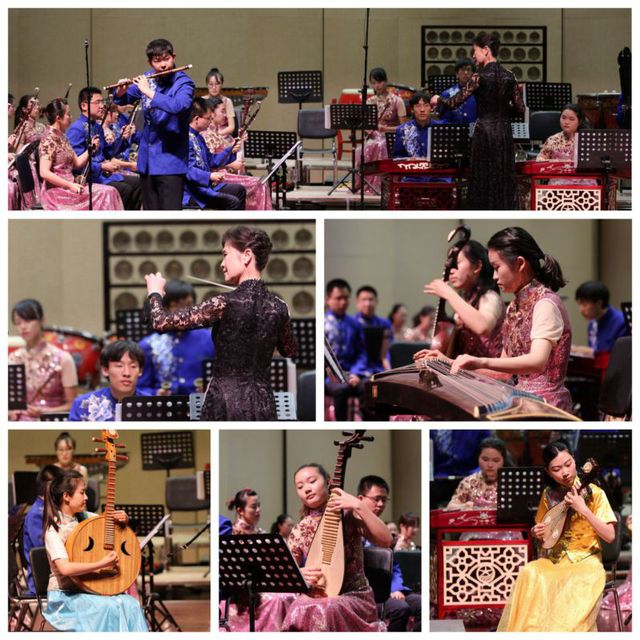
This concert for the university anniversary, also known as “The Most Beautiful Chinese Dream,” demonstrated the century-old university’s tradition of sincerity with aspiration and personality of erudition with responsibility, according to an organizer of the concert.
To implement what General Secretary Xi Jinping has emphasized in the symposium on literature and art, the National Music Research Center was established at Nanjing University, said this organizer. This center aims to study and carry forward China’s brilliant traditional musical culture, and to create a forum for the inheriting, disseminating, sharing, researching and innovation of Chinese national music.

